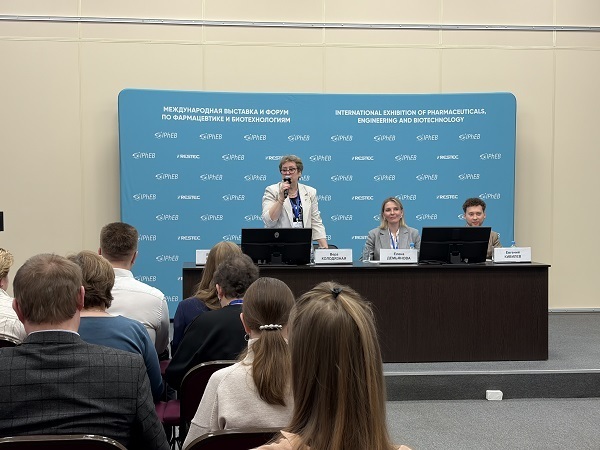
A section titled "Promising Directions of Biotechnology in Manufacturing and Scientific Research" was held. Participants examined the full cycle of the industry's development: from personnel training and fundamental research to industrial development of biopharmaceuticals and the formation of the future bioeconomy.
The section was moderated by Vera Kolodyaznaya, Head of the Department of Biotechnology at the St. Petersburg State Chemical and Pharmaceutical University, Candidate of Biological Sciences, Associate Professor, who noted the growing role of interdisciplinary interaction between science and industry in training a new generation of specialists.
The topic of education was also addressed by Olga Topkova, who presented a report on the formation of professional competencies in the field of biotechnology. It was emphasized that modern personnel training requires the integration of fundamental education with practice-oriented tasks of the pharmaceutical industry, including student participation in real scientific and production projects.
The practical perspective of interaction between education and industry was continued by Andrey Belyankin, who examined the development of applied master's programs based on production and research laboratories. According to him, such formats allow enterprises to train specialists for their own technological needs, but they are accompanied by a number of risks, including the conflict between scientific openness and industrial confidentiality, professional burnout of young specialists, and employer competition for trained personnel.
An industrial perspective on accelerating drug development was presented by Evgeny Kivilev, Director of the Pharmaceutical Development Department at BIOCAD. The speaker noted that reducing the drug's path to the patient is currently achieved through three complementary factors: the use of biomarkers as predictors of clinical success, the implementation of platform technologies that ensure process reproducibility, and the application of artificial intelligence tools for study planning and design. Special attention was paid to the transition toward developing drugs for biologically defined groups of patients within a single nosology, which increases the predictability of outcomes and treatment efficacy.
The topic of platform solutions was continued by Elena Demyanova (Pharmasyntez-Nord JSC), who presented approaches to the development of monoclonal antibodies. The report covered the key stages of biopharmaceutical development: selection of the selection system and parental cell line, obtaining stable producers, strategies for genetic material integration, and selection of optimal vector constructs and nutrient media. The use of platform technologies, according to the speaker, can significantly reduce development time and lower costs while maintaining high final product quality.
The development of innovative biological drugs was the subject of a report by Rahim Shukurov, Director of the Pharmaceutical Analysis Directorate at GENERIUM, Candidate of Biological Sciences. The speaker addressed the problem of the blood-brain barrier, which limits drug delivery to the central nervous system. As a solution, the "Trojan horse" strategy, based on receptor-mediated transport via the insulin receptor, was presented. As a result of the research, the drug verenafusp alfa was developed and is currently in clinical trials for the treatment of mucopolysaccharidosis type II.
Fundamental research as a source of applied solutions was demonstrated by Vladimir Volodin, Doctor of Biological Sciences, Professor at Peter the Great Polytechnic University. The report focused on phytonutrients and adaptogens as drivers of the bioeconomy. Through large-scale research, more than 700 plant species were analyzed for ecdysteroids, followed by experimental studies of their biological activity. The results obtained led to the creation of several registered biologically active products used in rehabilitative medicine and functional nutrition. The speaker also presented a distributed production model featuring a low entry threshold for investors and the potential for scaling innovative developments.
Economic and technological aspects of industry development were continued by Maxim Kovtun, a postgraduate student at SPHFA, who presented a report on industrial enzymology as the foundation of the bioeconomy. The biotechnology economy was defined as a system for converting renewable biological resources into high-value-added products, including pharmaceutical substances, biomaterials, and bioenergy. According to international experts, the global bioeconomy market already exceeds $5 trillion and is demonstrating steady growth. It was noted that industrial enzyme production plays a key role in biocatalysis, diagnostics, and drug creation, and the development of this area is considered a strategic priority for technological development.
The report also addressed current industry challenges, including the need to optimize monoclonal antibody purification processes, reduce product losses, and find alternatives to classical schemes using Protein A. Among the promising solutions mentioned were the use of mixed-mode sorbents and process optimization at physiological pH values, which can increase production efficiency.
Summing up the results of the section, it is worth noting that biotechnology is today being shaped as a key intersection point of science, industry, and economics. The presented reports demonstrated the industry's movement toward platform solutions, digitalization of development, personalized medicine, and sustainable bioproduction models.
The section was moderated by Vera Kolodyaznaya, Head of the Department of Biotechnology at the St. Petersburg State Chemical and Pharmaceutical University, Candidate of Biological Sciences, Associate Professor, who noted the growing role of interdisciplinary interaction between science and industry in training a new generation of specialists.
The topic of education was also addressed by Olga Topkova, who presented a report on the formation of professional competencies in the field of biotechnology. It was emphasized that modern personnel training requires the integration of fundamental education with practice-oriented tasks of the pharmaceutical industry, including student participation in real scientific and production projects.
The practical perspective of interaction between education and industry was continued by Andrey Belyankin, who examined the development of applied master's programs based on production and research laboratories. According to him, such formats allow enterprises to train specialists for their own technological needs, but they are accompanied by a number of risks, including the conflict between scientific openness and industrial confidentiality, professional burnout of young specialists, and employer competition for trained personnel.
An industrial perspective on accelerating drug development was presented by Evgeny Kivilev, Director of the Pharmaceutical Development Department at BIOCAD. The speaker noted that reducing the drug's path to the patient is currently achieved through three complementary factors: the use of biomarkers as predictors of clinical success, the implementation of platform technologies that ensure process reproducibility, and the application of artificial intelligence tools for study planning and design. Special attention was paid to the transition toward developing drugs for biologically defined groups of patients within a single nosology, which increases the predictability of outcomes and treatment efficacy.
The topic of platform solutions was continued by Elena Demyanova (Pharmasyntez-Nord JSC), who presented approaches to the development of monoclonal antibodies. The report covered the key stages of biopharmaceutical development: selection of the selection system and parental cell line, obtaining stable producers, strategies for genetic material integration, and selection of optimal vector constructs and nutrient media. The use of platform technologies, according to the speaker, can significantly reduce development time and lower costs while maintaining high final product quality.
The development of innovative biological drugs was the subject of a report by Rahim Shukurov, Director of the Pharmaceutical Analysis Directorate at GENERIUM, Candidate of Biological Sciences. The speaker addressed the problem of the blood-brain barrier, which limits drug delivery to the central nervous system. As a solution, the "Trojan horse" strategy, based on receptor-mediated transport via the insulin receptor, was presented. As a result of the research, the drug verenafusp alfa was developed and is currently in clinical trials for the treatment of mucopolysaccharidosis type II.
Fundamental research as a source of applied solutions was demonstrated by Vladimir Volodin, Doctor of Biological Sciences, Professor at Peter the Great Polytechnic University. The report focused on phytonutrients and adaptogens as drivers of the bioeconomy. Through large-scale research, more than 700 plant species were analyzed for ecdysteroids, followed by experimental studies of their biological activity. The results obtained led to the creation of several registered biologically active products used in rehabilitative medicine and functional nutrition. The speaker also presented a distributed production model featuring a low entry threshold for investors and the potential for scaling innovative developments.
Economic and technological aspects of industry development were continued by Maxim Kovtun, a postgraduate student at SPHFA, who presented a report on industrial enzymology as the foundation of the bioeconomy. The biotechnology economy was defined as a system for converting renewable biological resources into high-value-added products, including pharmaceutical substances, biomaterials, and bioenergy. According to international experts, the global bioeconomy market already exceeds $5 trillion and is demonstrating steady growth. It was noted that industrial enzyme production plays a key role in biocatalysis, diagnostics, and drug creation, and the development of this area is considered a strategic priority for technological development.
The report also addressed current industry challenges, including the need to optimize monoclonal antibody purification processes, reduce product losses, and find alternatives to classical schemes using Protein A. Among the promising solutions mentioned were the use of mixed-mode sorbents and process optimization at physiological pH values, which can increase production efficiency.
Summing up the results of the section, it is worth noting that biotechnology is today being shaped as a key intersection point of science, industry, and economics. The presented reports demonstrated the industry's movement toward platform solutions, digitalization of development, personalized medicine, and sustainable bioproduction models.