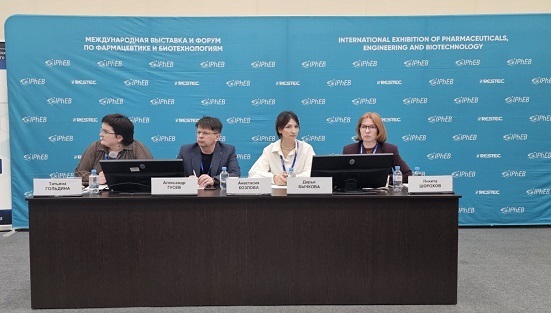
As part of the conference "Dialogues on Clinical Research," a session on "RWD/RWE in the EAEU" was held, opened by Tatiana Goldina, Candidate of Biological Sciences, Head of the RWE Working Group, Senior Lecturer at RSUH. Experts discussed the implementation of RWE in medicine and pharmaceuticals, key barriers, and the creation of a unified knowledge ecosystem.
Nikita Shorokhov (Pirogov National Medical and Surgical Center) defined RWE as a strategic driver for the development of healthcare organizations. He emphasized that real-world data serve as raw material for managerial decisions, but their implementation is hindered by a lack of organizational memory, personnel shortages, and weak IT infrastructure.
Alexey Yunin (Eisai) cited statistics: over 2.5 years, the share of drugs approved based on RWE grew from 75% to 96%. He noted that the main barriers remain regulatory uncertainty and data quality, and that success requires coordination among regulators, the state, and business.
Natalia Andreeva (AMFP) shared her experience in project management. According to her, success begins with a scientific concept, and the entire cycle from idea to launch takes about 8 months and requires an experienced team. She detailed the stages: from supplier selection to operational control and documentation management.
Daria Bychkova (AMFP) emphasized that for the industry, RWE is a tool for cost optimization and product differentiation. She spoke about the Association's work, which has been developing this direction since 2020 through interaction with regulators and educational projects for doctors and students.
Alexander Gusev (Webiomed, Central Research Institute of Health Organization and Informatics of the Ministry of Health of the Russian Federation) presented practical experience in analyzing electronic medical records using AI. The platform is connected to 42 regions of the Russian Federation and over 4,000 medical organizations (66+ million patients). He presented a case study: an algorithm for detecting kidney disease with 98% accuracy and an analysis of 16,000 cases of adverse reactions.
Nikolay Alexandrov (Lex Engineering LLC) highlighted legal risks. He stressed that the opacity of the regulatory framework creates "gray zones," and new requirements include mandatory separate consent and data localization on Russian territory. The speaker detailed the new requirements, including mandatory separate consent and data localization on Russian territory.
Sergey Simeniv (X7 Research) emphasized in his report that successful feasibility assessment of real-world clinical practice studies requires interdisciplinary competencies and well-coordinated interaction between different teams. He highlighted key industry problems, including difficulties in data harmonization from different sources and differences in laboratory parameters, and noted the growing influence of regulatory requirements on the protocol writing process. The speaker concluded by stating the need to integrate modern technologies to optimize processes, which in turn requires qualified specialists to work with new tools.
Experts also discussed the creation of infrastructure for knowledge exchange.
Tatiana Goldina (RWD/RWE expert, lecturer at RSUH) spoke about the first Russian-speaking community of RWE specialists, whose goal is the systematic development of methodology through a "Knowledge Hub" and educational courses.
Anastasia Kozlova (Nizhpharm JSC) presented the ProRWE ecosystem — a platform that gained 900 subscribers and held over 10 webinars in 26 weeks. The speaker announced expansion through new channels (VK, website) and QR codes for access to materials.
Tatiana Dunaeva (Nizhpharm JSC) presented the "RWE Prosvet" project — the first publicly accessible knowledge base. The hub structures information through articles, a glossary, and legislative reviews, maintaining high standards for material quality and inviting experts to collaborate.
Nikita Shorokhov (Pirogov National Medical and Surgical Center) defined RWE as a strategic driver for the development of healthcare organizations. He emphasized that real-world data serve as raw material for managerial decisions, but their implementation is hindered by a lack of organizational memory, personnel shortages, and weak IT infrastructure.
Alexey Yunin (Eisai) cited statistics: over 2.5 years, the share of drugs approved based on RWE grew from 75% to 96%. He noted that the main barriers remain regulatory uncertainty and data quality, and that success requires coordination among regulators, the state, and business.
Natalia Andreeva (AMFP) shared her experience in project management. According to her, success begins with a scientific concept, and the entire cycle from idea to launch takes about 8 months and requires an experienced team. She detailed the stages: from supplier selection to operational control and documentation management.
Daria Bychkova (AMFP) emphasized that for the industry, RWE is a tool for cost optimization and product differentiation. She spoke about the Association's work, which has been developing this direction since 2020 through interaction with regulators and educational projects for doctors and students.
Alexander Gusev (Webiomed, Central Research Institute of Health Organization and Informatics of the Ministry of Health of the Russian Federation) presented practical experience in analyzing electronic medical records using AI. The platform is connected to 42 regions of the Russian Federation and over 4,000 medical organizations (66+ million patients). He presented a case study: an algorithm for detecting kidney disease with 98% accuracy and an analysis of 16,000 cases of adverse reactions.
Nikolay Alexandrov (Lex Engineering LLC) highlighted legal risks. He stressed that the opacity of the regulatory framework creates "gray zones," and new requirements include mandatory separate consent and data localization on Russian territory. The speaker detailed the new requirements, including mandatory separate consent and data localization on Russian territory.
Sergey Simeniv (X7 Research) emphasized in his report that successful feasibility assessment of real-world clinical practice studies requires interdisciplinary competencies and well-coordinated interaction between different teams. He highlighted key industry problems, including difficulties in data harmonization from different sources and differences in laboratory parameters, and noted the growing influence of regulatory requirements on the protocol writing process. The speaker concluded by stating the need to integrate modern technologies to optimize processes, which in turn requires qualified specialists to work with new tools.
Experts also discussed the creation of infrastructure for knowledge exchange.
Tatiana Goldina (RWD/RWE expert, lecturer at RSUH) spoke about the first Russian-speaking community of RWE specialists, whose goal is the systematic development of methodology through a "Knowledge Hub" and educational courses.
Anastasia Kozlova (Nizhpharm JSC) presented the ProRWE ecosystem — a platform that gained 900 subscribers and held over 10 webinars in 26 weeks. The speaker announced expansion through new channels (VK, website) and QR codes for access to materials.
Tatiana Dunaeva (Nizhpharm JSC) presented the "RWE Prosvet" project — the first publicly accessible knowledge base. The hub structures information through articles, a glossary, and legislative reviews, maintaining high standards for material quality and inviting experts to collaborate.